Summary:
- Forging financial documentation is one common type of rental fraud, according to the American Apartment Owners Association
- How to spot a fake pay stub can require reviewing inconsistent payment dates, suspiciously round salary numbers, deductions that don’t add up, font and layout errors, blurry logos and more, according to Property Craft
- Sometimes real vs. fake pay stubs are almost impossible to spot, due to AI and sophisticated fraudsters, according to Forbes
- It’s suggested to use outside verification to confirm pay stub information is real, such as contacting the employer directly and running tenant screening
Disclosure and Disclaimer
This post only contains educational information. No financial, tax or legal advice.
This information is for educational purposes only and we do not guarantee the accuracy or completeness of this information. This website may contain links to third party websites. We are not responsible for their content or data collection. Trademarks used in this material are property of their respective owners and no affiliation or endorsement is implied. Remember that this material is intended to provide you with helpful information and is not to be relied upon to make decisions. This information does not constitute financial, tax or legal advice and you should consult your own professional adviser regarding your situation.
Someone might use fake pay stubs, like a fake ID, to get in the door when they don’t belong. If you fall for this common rental scam, you risk a huge hit to your property business—especially these days.
According to Forbes, fraud committed by rental applicants is on the rise – and is only amplified by the booming use of Artificial Intelligence. Now, scammers can create nearly error-free, passable documents and entire identities, leaving landlords questioning the truth.
This is why it may be important to vet all potential residents with a background check company like SmartMove®. To help catch scammers in their tracks, it may not be enough to just look over documents. Instead, verify the information with data from a trustworthy source.
This article covers a common type of rental fraud: fake pay stubs. Read the ins and outs of real vs. fake pay stubs in the rental market, how to help spot fraudulent documents, like fake paystubs, and landlord tips to help protect yourself.
Why Do Landlords Ask Tenants for Pay Stubs?
Some landlords request pay stubs to help verify a potential tenant can meet the rental rate. Why? If a tenant stops paying rent, you may have to start eviction proceedings. Eviction can be an expensive and time-consuming process, which is why many landlords try hard to avoid it.
Tenant Financial Screening
When sizing up potential rental residents, landlords conduct many types of background checks, including financial screening.
Financial screening usually includes things like:
| Screening Type | How it Can Help Landlords |
|---|---|
| Credit report | Helps reveal tenant debt, payment patterns, and financial habits, which may help landlords determine if someone is likely to pay rent |
| ResidentScore® | A SmartMove exclusive, this proprietary score is designed to help predict future eviction risk better than a traditional credit score |
| Income Verification | Landlords review documents like pay stubs, tax return documents, Income Insights reports, and more to learn if someone makes enough income to meet rent every month |
Reviewing a potential tenant’s finances may be able to help you better assess if a rental applicant:
- Makes enough finances to suffice your monthly rent amount
- Has steady financial habits that mean they’re likely to pay every month

Pro Tip:
If your tenant leaves or arrives in the middle of a month, you may have a few options for how to handle payments. Read how to calculate prorated rent and the pros and cons of this practice.
The Problem with Getting Documents from Tenants
Completely fabricating financial and employment documents, like fake pay stubs, is one of the most common types of rental scams, according to the American Apartment Owners Association (AAOA).
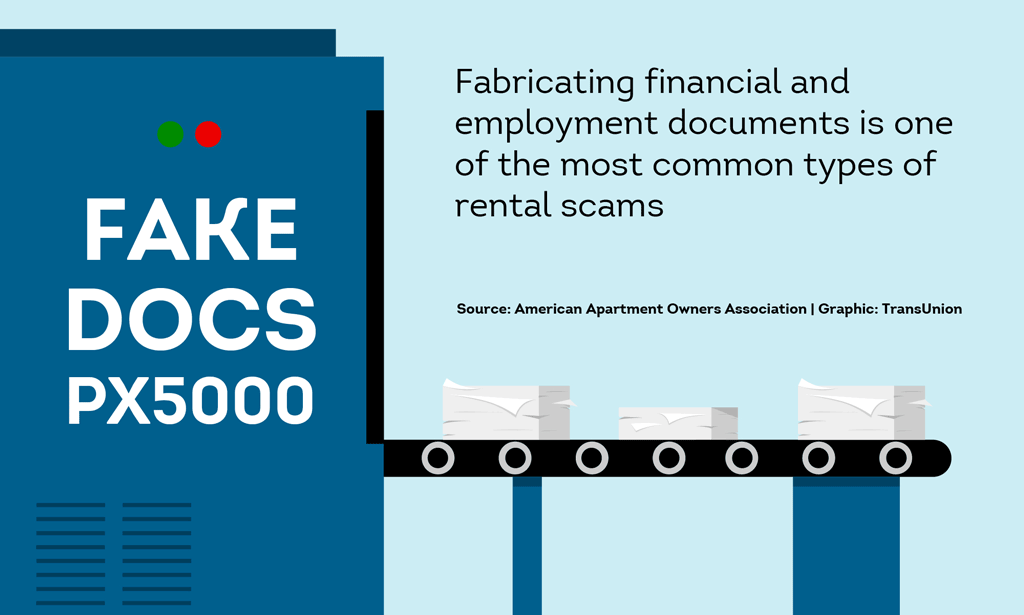
This means if you accept documents from rental applicants directly, you may risk getting information from potentially fake pay or check stubs. The AAOA article also points out that some of the most common types of fraudulent documents are fake:
- Checks
- Employment history or references
- Credit reports
- Pay stubs
- Rental history and past landlord contact information
Be cautious when accepting these documents from tenants directly. Consider backing up self-reported information with data through tenant screening.
Why Would Tenants Provide Fake Pay Stubs on Rental Applications?
Some tenants may not meet your standards. They may try to make themselves appear like a more qualified applicant by providing altered or even totally fake pay stubs.
Rent to Income Ratio
Many landlords require tenants to meet a certain rent-to-income ratio. According to Bay Property Management Group, this calculation compares your potential rent payment to your rental applicant’s salary.
The article also explains that a general standard is for potential tenants to earn at least three times the monthly rental rate, but this can fluctuate depending on the market.
- Example: If your monthly rental rate is $1,200, you might require tenants to make at least $3,600/month.
What Tenants Might Want to Cover Up with Fake Pay Stubs
There could be several reasons a rental applicant wants to pull the wool over a landlord’s eyes. Tenants who provide fake pay stubs could be covering for things like:
- Recent unemployment
- A low credit score
- A pile of maxed out credit cards
These potential financial warning signs could cause trouble for your rental business, so it can be crucial to know how to deal with fake pay stubs and other fraudulent documents.
Pro Tip:
If your tenant doesn’t qualify to meet your standards but is still an otherwise good candidate, you may have other options. You could consider requiring a guarantor or co-signer on the lease to help ensure you get paid.
What Should You review when evaluating If a Pay Stub is Real or Fraudulent?
As the Forbes article explains, in the digital age of AI-created documents, it can be nearly impossible for a regular person to tell if pay stubs or other rental documents are genuine or fake. Even the FBI issued a warning about the prevalence of AI in financial fraud.
This is why it can be helpful to verify tenant-supplied documents with data through tenant screening.
Even so, there are a few things to watch out for to check if a document is a fake vs. a real pay stub.
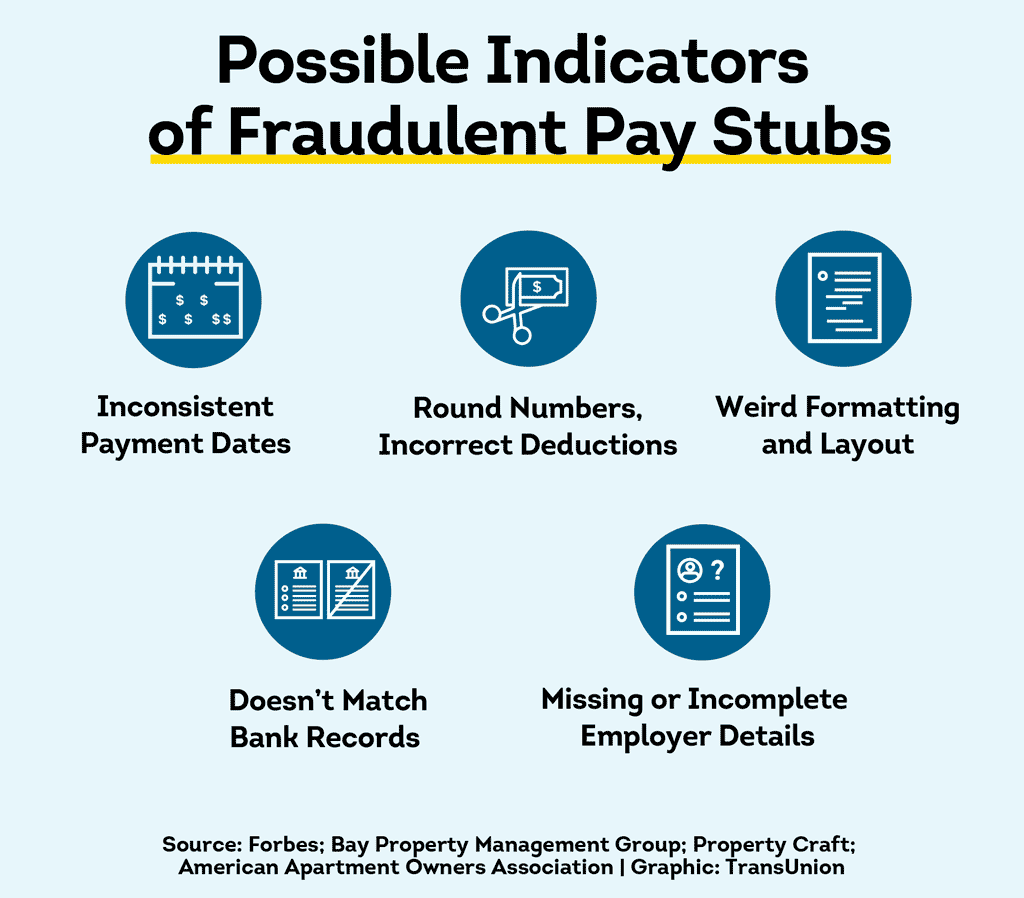
| What to Check | What to Look For |
|---|---|
| Payment dates | Check multiple pay stubs. Are the dates consistent with a professional payroll schedule? Are they being paid on the same day(s) of the month? |
| Payment amounts and deductions | Does the salary amount seem correct? Is it a round number? Are deductions shown? Do the deductions make sense for the expected tax rate? |
| Formatting and Layout | Are the fonts and alignment consistent? Are there any weird spacing or layout issues? Is the template overly generic? Is the company logo blurry? |
| Employer Details | Are the employer details present and complete? Does it match what’s available online about the company? |
| Bank Records | Do the pay stub dates and amounts correspond to the rental applicant’s bank records? |
Inconsistent Payment Dates
Bay Property Management Group explains that one subtle tell of fake pay stubs can be found in payment dates. The article explains most full-time jobs pay employees at regular intervals, either on a specific day of the month or every two weeks.
If you have multiple pay stubs from a rental applicant with inconsistent payment dates, it could be a sign the documents are fake.
Round Numbers and Incorrect Deductions
Another place to look for potential fake documents is in the numbers on the check stubs themselves. Management site Property Craft advises to check the following:
- The payment amount. Real payroll checks are rarely exact, round numbers. It’s more likely someone’s paycheck looks like $4,512.63 rather than $4,500.
- Tax deductions. Payroll deductions for things like Social Security and Medicare should align to a certain percentage. If there are no deductions on the check or the percentage seems off, it could be a sign the pay check stub is fake.
Weird Formatting and Layout
Fake pay stubs may also have things like overly generic templates, odd spacing, or letters or numbers that are not aligned with the rest, according to the Bay Property Management Group article.
Property Craft adds that fake documents may have blurry logos, inconsistent fonts, or layouts that are slightly off.
Missing or Incomplete Employer Details
The American Apartment Owners Association article also explains to check out the employer details. Real pay stubs often include the company’s name, address, and logo.
Often, a real vs. fake pay stub might also have the Employer Identification Number (EIN), which you can check to make sure it has the correct number of digits and is consistent across pay stubs.
Doesn’t Match Bank Records
Finally, the Property Craft article suggests comparing the pay stubs to your rental applicant’s bank statements (if you have them). That way, you can see if the payment dates and amounts line up to what the pay stubs say.
What are Some useful Ways to Help Verify a Tenant’s Income?
There are a few things you can do to help protect your property business from scammers that use fake pay stubs.
Review Documents Carefully
According to the American Apartments Owners Association, how to spot fake pay stubs comes down to taking the time to fully examine pay stubs. Check for inconsistencies in fake vs. real pay stubs like the red flags listed in the section above.
Validate Details with Employer
Bay Property Management Group advises that you validate the details listed on tenant pay stubs with employers directly. They recommend you can first do an internet search to make sure the employer is a real business and matches the contact information on the pay stubs.
Then, you can reach out to the employer to confirm the details are correct. Some employers provide portals or websites where you can request this information. Others may not be willing to provide this data, so be prepared if the employer won’t disclose these details.
Get Data with Tenant Screening Reports
Some fake pay stubs may be poor quality and easy to spot with the red flags listed above. Others may be so convincing, even a forensic document expert may have trouble spotting the fake pay stub.
This is why it can be essential to help verify tenant-supplied information with background checks through a reputable company. Reports like a credit check and Income Insights can help you confirm the information the rental applicant told you makes sense.
Pro Tip:
Scammers can be a risk regardless of the length of your lease. It’s critical to run tenant screening whether you have a long-term or short-term agreement.
Help Protect Against Fraudsters with SmartMove Tenant Screening
As a landlord, you can’t always trust your gut. And, unfortunately, you can’t always trust documents tenants provide either. Instead, help vet rental residents with data. Get fast, flexible tenant screening reports through SmartMove.
Is your tenant using fake pay stubs to cover up financial deficiencies? Help learn about their history with debt and money with:
- A credit check can help you learn about someone’s financial history, debt load, and history of paying their bills on time or not
- An exclusive ResidentScore is designed to assess potential eviction risk a tenant may bring
- Income Insights help you confirm whether your tenant’s real-world income matches what they claim on the rental application
Then, responsible tenant screening doesn’t stop with analyzing fake vs. real pay stubs and other financial documentation. Help keep your property protected by getting a criminal background check and previous eviction report.
These reports can help you pinpoint past problems that could put your property business at risk. You can even run identity verification to help confirm your rental applicant is who they say they are.
All easy-to-read, reports are backed by TransUnion––a major credit agency with decades of data expertise.
Created specifically for independent landlords with only occasional fake pay stub screening needs, there are no sign-up costs, subscriptions, minimums, or hidden fees. Simply create a free account and start screening.
Don’t let someone with fake pay stubs and bad intentions crash your party. Help protect your property with fast, efficient tenant screening through SmartMove.
Know your applicant.

Fake Pay Stub FAQs
According to Bay Property Management Group, the traditional standard rent to income ratio is three-to-one. This means a tenant should make at least three times your monthly rental rate.
However, the article also points out that this standard is not a hard and fast rule and varies by location. For example, you may have to relax this expectation in more expensive markets where rent eats up more of income.
You should look for suspiciously round and even salary numbers, deduction percentages that don’t make sense, layout inconsistencies, changing fonts, inconsistent pay periods, unusual formatting, and more, according to Property Craft.
However, some fake pay stubs may be nearly indistinguishable from the real thing. That’s why it’s important to validate information on pay stubs both with employers directly and through background check reports.
According to the American Apartment Owners Association, common tenant scams include: providing checks that are fake or written for over the amount owed, falsifying records like credit reports, employment records, or fake pay stubs, prolonging eviction proceedings, using residential property for commercial purposes, refusing to pay rent once they’re on the property, hiding damages at move-out, lying about the number of tenants, and more.

Additional Disclosure:
For complete details of any product mentioned in this article, visit www.transunion.com. This site is governed by the TransUnion Rental Screening Privacy Policy Privacy Notice located at TransUnion Rental Screening Solutions, Inc. Privacy Notice | TransUnion.